Clinical answers that show their working.
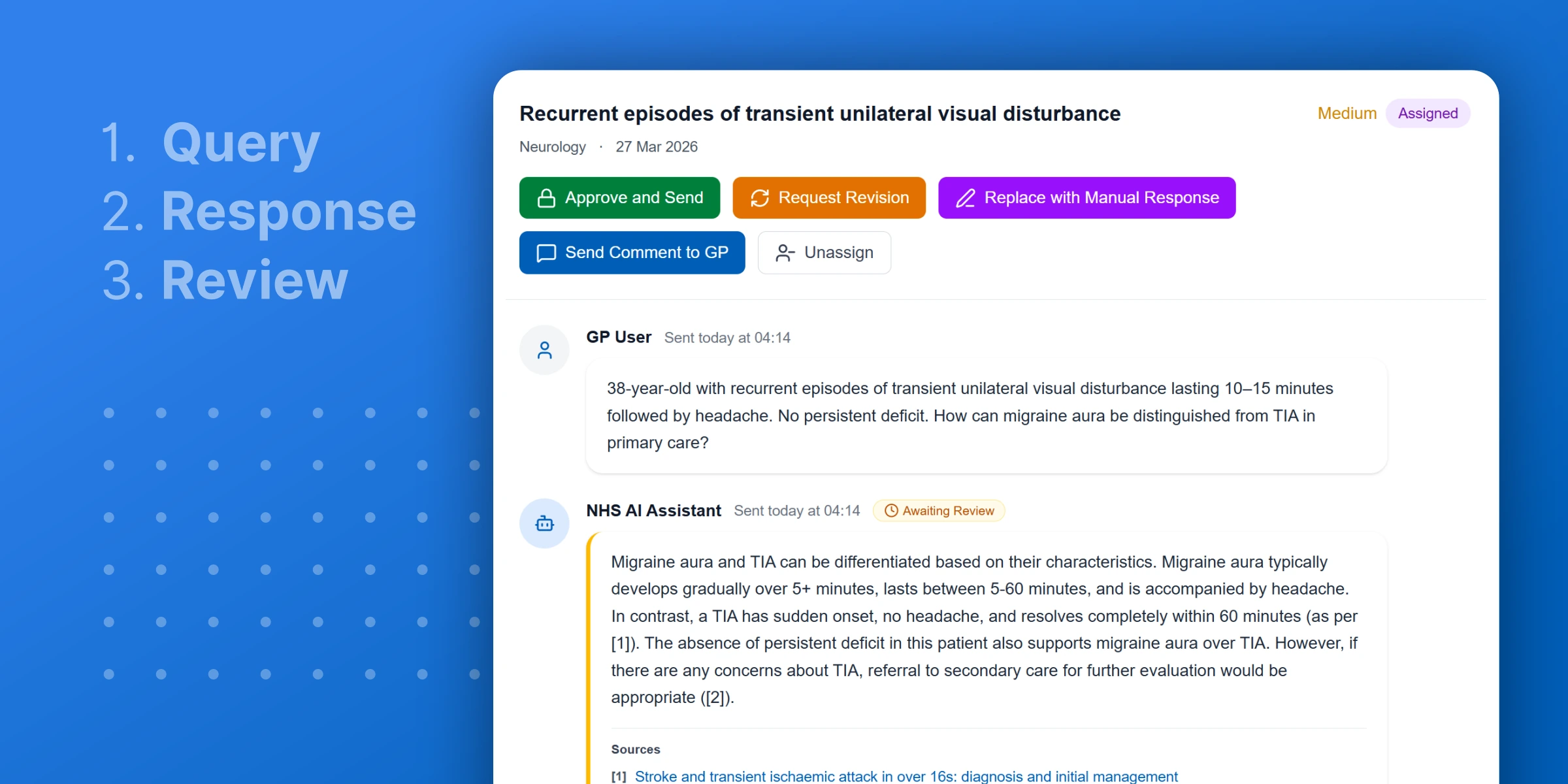
NHS Advice & Guidance made every GP query a manual task for a specialist, including simple and repeated questions. Ambience AI drafts a grounded response with page-level citations, ready for a specialist to approve or edit before it reaches the GP.
The problem
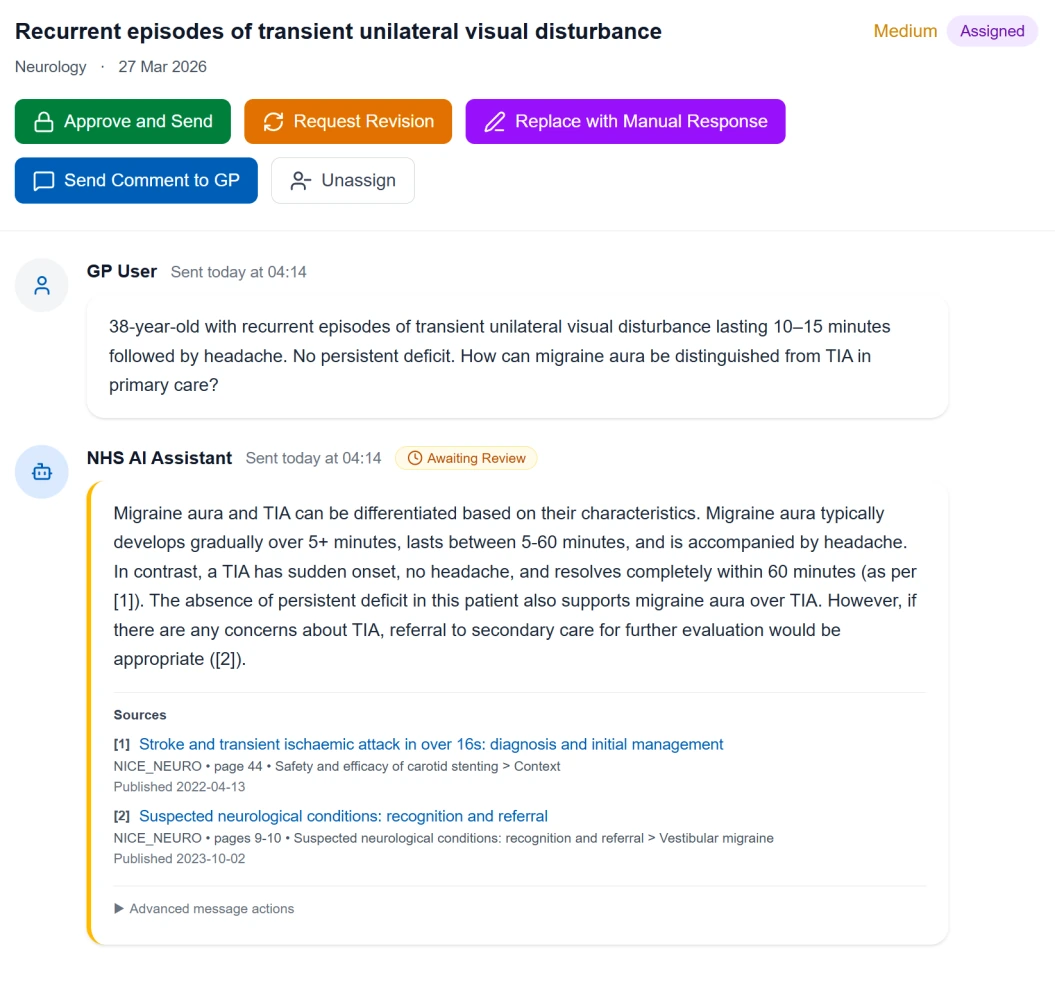
The NHS Advice & Guidance system let GPs submit clinical questions to specialists, who reviewed and answered them when capacity allowed. Every query entered the same manual queue, whether it involved a complex case or a question the team had answered many times before.
For routine queries, much of the work was finding the relevant guidance and pasting it into a response. The brief was to reduce that repetition without removing clinical oversight: draft a grounded, cited answer for the specialist to approve, edit or replace before the GP saw it.
What we built
A retrieval pipeline over NICE and BSR guidance, wrapped in a clinical workflow rather than a chat window.
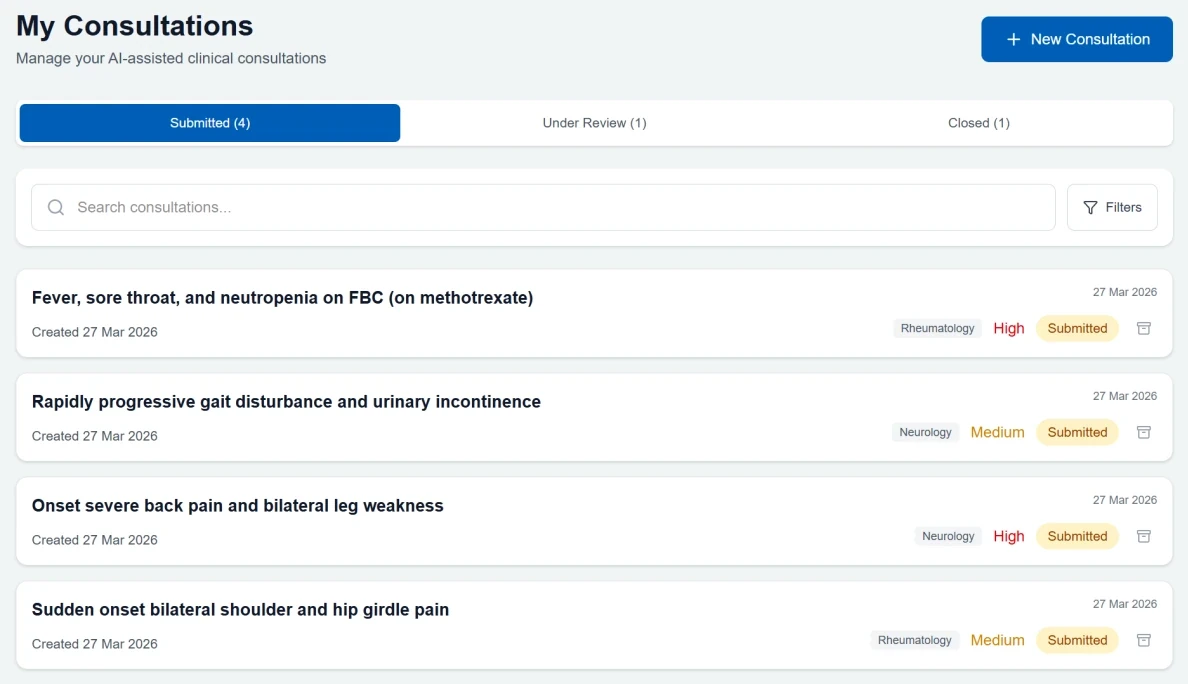
- Answers from the guideline, not from memory. The documents are chunked with their sections and tables intact, retrieved by vector search, and handed to the model as passages; so a numbered reference points at the text that produced the sentence.
- A refusal instead of a guess. Below the confidence threshold the system declines, and the case still goes to a human.
- A specialist in front of every answer. They approve, request a revision, or replace it entirely. The GP sees nothing until they act.
- 01
GP asks
Age, sex, specialty and urgency
- 02
Retrieve
NICE and BSR passages
- 03
Draft answer
Every claim numbered
- 04Required gate
Specialist review
Approve, revise or replace
- 05
GP sees answer
Sources attached
The interesting part of a clinical AI product isn't the answer. It's everything that has to be true before anyone is allowed to read it.
Grounding
Every reference carries the guideline title, the page, the section path and the publication date, so a specialist can check a claim in about ten seconds. That is the only reason a human review step is affordable at all.
Details
- Context
- UCL Industry Exchange Network, with the NHS and Intel
- Timeline
- 24 weeks, October 2025 – March 2026
- Frontend
- React · TypeScript · Vite · SSE answer streaming with a polling fallback · Recharts · Vitest · Playwright
- Backend
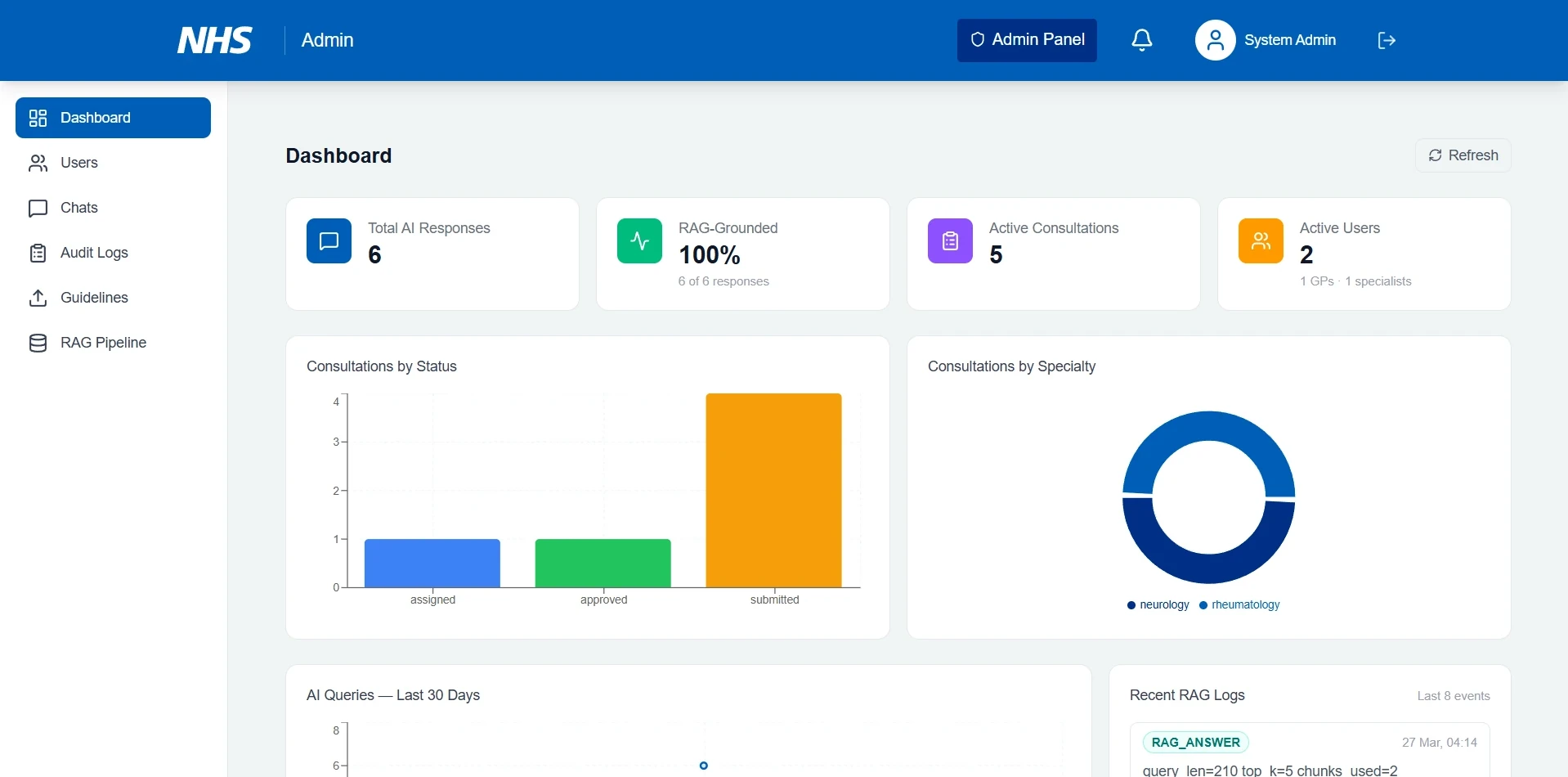
- FastAPI · PostgreSQL + pgvector · Alembic · JWT auth · Redis queue
- Retrieval
- PDF extraction · section- and table-aware chunking · cosine vector search · scheduled NICE re-crawl
- Inference
- Med42 via Ollama, local-first, with a configurable hosted fallback
- Delivery
- Docker Compose, seven services · nginx TLS · health checks and dependency ordering